
By L. Ryan Pinder K.C. | Pinder Commercial Chambers
For internationally invested Brazilian families, succession planning is increasingly about more than deciding who will ultimately own the family’s assets. A founder may want to begin transferring wealth while retaining income and a measure of control. Children may ultimately want different investment strategies. One branch may wish to retain real estate while another prefers financial assets.
These questions can be reduced to four distinct issues: who owns the wealth, who enjoys its economic benefits, who makes decisions, and when different family branches should become independent.
Recent Bahamian legislation provides a particularly interesting toolkit. The Usufruct Interest Act, 2026, the statutory demerger provisions of the International Business Companies Act, and the Segregated Accounts Companies Act, 2025 can be used separately or together so that a family’s legal structure can evolve as the family itself evolves.
The objective is not to manufacture a tax result. It is to create a coherent legal architecture for ownership, enjoyment, governance, succession and eventual separation.
The planning question has changed
Brazil’s international tax landscape has changed materially. Law No. 14,754 of 2023 established rules for foreign investment income and controlled foreign entities, including annual taxation in specified circumstances. Brazilian control analysis can also look beyond registered ownership to governance and decision-making rights.
Complementary Law No. 227 of 2026 established general national rules for ITCMD, including rules relevant to donations, succession and cross-border situations. Applicable State or Federal District rules and the facts of the transaction remain important.
International planning should therefore begin with the family’s legal and commercial requirements: who should own, receive income and vote; whether children should remain invested together indefinitely; and how different assets or family branches can eventually separate.
Usufruct: separating ownership from enjoyment
The Usufruct Interest Act, 2026 came into force on 1 April 2026. It provides a Bahamian framework for separating legal ownership from defined rights of use, enjoyment, income and governance for a limited period.
The Act applies to a broad range of property, including shares and other equity interests. For corporate interests it addresses voting rights, dividends and capital, as well as stock splits, mergers, demergers and other corporate reorganisations. This makes it particularly useful where succession is intended to occur in stages.
Case Study One: Give the ownership, retain the usufruct
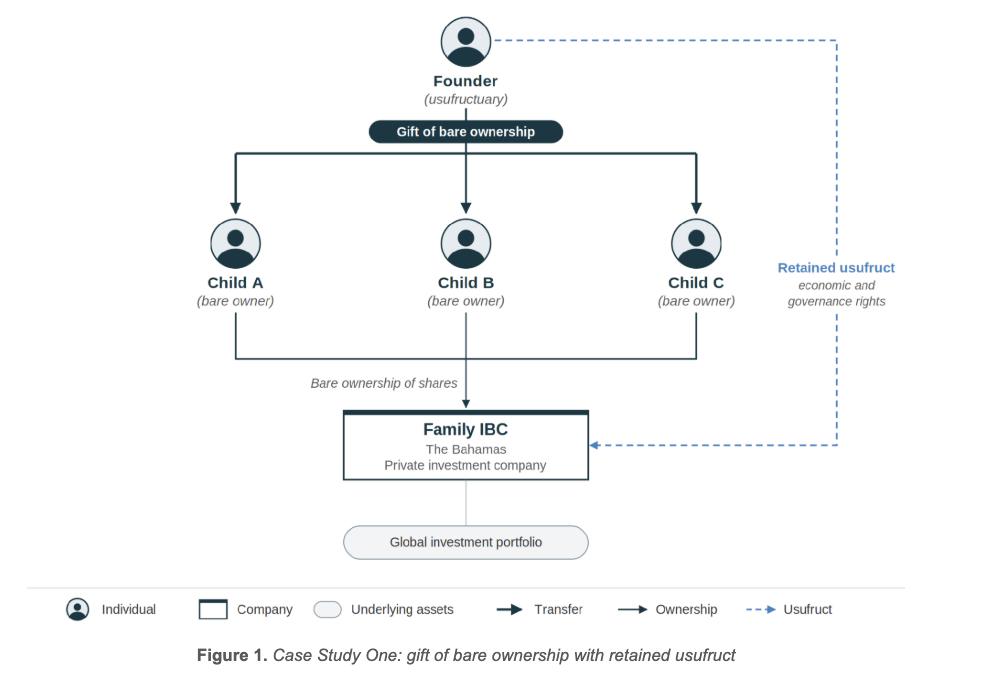
Assume a Brazilian founder owns the shares in a Bahamian International Business Company (IBC) holding a global investment portfolio and wishes to begin succession planning for three children.
Instead of an outright transfer of every incident of ownership, the founder transfers the bare ownership (nua-propriedade) of the shares to the children while reserving a usufruct. The children hold the underlying ownership subject to the usufruct, while the usufruct agreement can regulate the founder’s retained economic and governance rights consistently with the statute.
When the usufruct terminates, the children’s ownership is no longer subject to the retained interest. Ownership can therefore move before enjoyment and governance have to move.
Brazilian advisers must separately determine the consequences of the transfer, valuation, ITCMD, income attribution and whether retained governance rights affect Brazilian controlled-entity analysis. In particular, a usufruct that reserves voting or governance rights to the founder may leave the founder treated as the controller for Brazilian purposes, and a usufruct constituted under Bahamian law is not automatically characterised as a usufruto by Brazil; neither result should be assumed. The attraction of the structure is not an assumed tax exemption; it is the ability to define succession rights clearly while succession takes place in stages.
Demerger: separating family branches when they are ready
A structure that works at the beginning of a succession plan can become unsuitable if every family branch must remain economically tied together indefinitely.
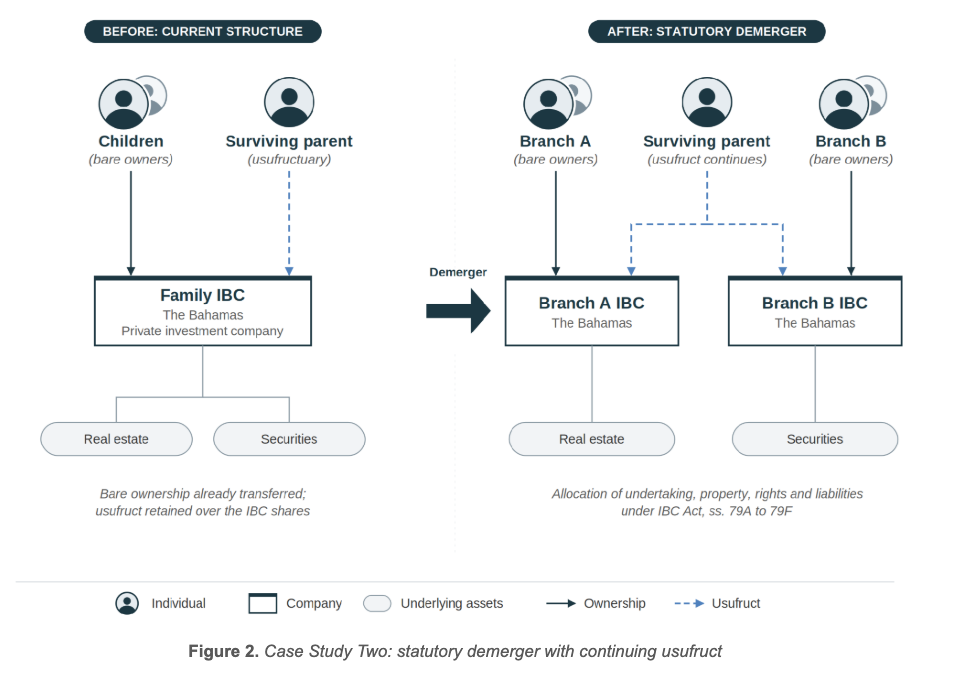
The International Business Companies (Amendment) (No. 2) Act, 2023 inserted sections 79A to 79F into the IBC Act. An IBC can demerge into two or more Bahamian IBCs. A statutory plan allocates the undertaking, property, rights and liabilities among the resulting companies and is supported by corporate approval, solvency and related statutory requirements.
The division is a corporate reorganisation rather than a requirement first to liquidate the holding company and sell or distribute every underlying asset. Its Bahamian corporate-law treatment does not, however, determine its Brazilian tax treatment.
Case Study Two: Succession today, separation later
Assume the family IBC holds an international real-estate portfolio and a securities portfolio. Bare ownership of the IBC shares has already passed to the children subject to the founder’s usufruct.
Years later, the family decides that different branches should hold the portfolios separately. Through a statutory demerger, the real-estate portfolio can be allocated to Branch A IBC and the securities portfolio to Branch B IBC, together with the liabilities and contractual rights properly associated with each.
The Usufruct Interest Act was deliberately drafted to address corporate reorganisations, including demergers. The transaction documents can therefore be designed so that the usufruct is appropriately reflected in the replacement interests, subject to the statute and the usufruct agreement.
The transfer of family ownership can take place at one point in time. The division of family assets between branches can take place later. Brazilian advisers must separately assess the tax consequences of the demerger, since its Bahamian corporate-law treatment does not bind Brazil’s characterisation.
Segregated accounts: designing for future separation from the beginning
The Segregated Accounts Companies Act, 2025 adds a further dimension.
A traditional Segregated Accounts Company, or SAC, remains one legal person, but assets and liabilities can be linked to different segregated accounts and are subject to statutory segregation. The account itself is not a separate legal person.
An Incorporated Segregated Accounts Company, or ISAC, takes a different approach. An Incorporated Segregated Account, or ISA, is itself incorporated as a company or IBC, with corporate capacity and its own constitutional and governance arrangements, while its assets and liabilities remain separately identifiable from those of the ISAC and other incorporated accounts.
For family planning, these are not merely asset-protection concepts. They can become succession architecture.
Case Study Three: Segregate now, separate later
Assume a Brazilian family has three principal investment pools: real estate, marketable securities and private investments.
A family SAC could allocate each portfolio to a separate segregated account while the family’s usufruct planning governs the appropriate ownership and retained rights. The family can therefore organise wealth by economic purpose or anticipated family branch while retaining a common corporate and administrative architecture.
Sections 75 onwards of the 2025 Act provide a statutory demerger mechanism for a SAC. The family can move through three stages: common administration inside one SAC; legal segregation of different portfolios during the transitional period; and eventual separation of selected accounts into standalone companies when the family is ready.
If separate corporate personality is desirable from the beginning, an ISAC may instead be used. An ISA does not use the SAC demerger procedure. Sections 83 to 85 permit an incorporated segregated account to continue as a company independent of its ISAC under the Companies Act or IBC Act, preserving corporate continuity.
The distinction is important: a traditional SAC offers segregation followed by statutory demerger; an ISAC offers separate incorporated accounts from inception followed by independent continuance of an ISA. Here too, segregation, demerger and continuance are Bahamian corporate-law mechanisms; their Brazilian tax, ITCMD and controlled-entity consequences must be assessed separately.
One architecture, several timelines
The principal advantage of combining these tools is not complexity. Properly used, it is the opposite.
The usufruct addresses the timing of ownership versus enjoyment and governance. The segregated-account regime addresses the organisation and ring-fencing of different pools of family wealth. Demerger or ISA continuance addresses when different family branches should become fully independent.
A founder can begin succession while remaining economically secure; the family can organise assets into identifiable branches while administering them together; and those branches can later become independent when circumstances warrant it. Succession planning is rarely a single transaction. It is a process that can last decades.
Brazilian advice must remain at the centre
The sophistication of the Bahamian structure makes coordination with Brazilian counsel more important, not less.
Brazilian advisers should consider controlled-entity rules, ITCMD, valuation, income attribution, foreign-asset reporting, the Common Reporting Standard (CRS) and other transparency requirements, beneficial ownership, bank and custodian requirements and the laws applicable to underlying property.
The fact that Bahamian company law gives a demerger a particular corporate-law treatment does not establish that Brazil or another jurisdiction must give it the same tax characterisation. The objective should be consistency: Bahamian corporate documents, the usufruct agreement, Brazilian tax treatment, banking records and family governance arrangements should describe the same economic reality.
Design for change, not permanence
Family structures are often designed around a snapshot. Families, however, change. Assets change. Children relocate. Investment objectives diverge. A founder’s role diminishes and governance needs evolve.
The better planning question is therefore not simply what structure the family should establish today. It is what legal architecture will allow the family to change tomorrow without dismantling everything it created yesterday.
The combination of the Bahamian usufruct, statutory demerger and the new segregated-account regime provides a compelling framework. A family can determine separately who enjoys, who owns and who decides, and when those rights should change and individual family branches should become independent.
Discuss Brazilian private wealth planning with PCC
Pinder Commercial Chambers advises on Bahamian corporate, private wealth and financial-services structures and works alongside Brazilian legal and tax advisers in designing cross-border arrangements. The appropriate structure depends on the family’s objectives, residence, assets, governance requirements and applicable Bahamian, Brazilian and other foreign laws.
[1] William Heuseler, “The Benefits of the Trust” (“Os benefícios do Trust”), Inteligência Financeira, 2023.
[2] William Heuseler, “Tax and Succession Aspects of Offshore Investments” (“Aspectos tributários e sucessórios de investimentos offshore”), Inteligência Financeira, 2025, addressing Law No. 14,754 of 2023.
[3] Brazil, Law No. 14,754 of 12 December 2023, particularly provisions concerning foreign investments and controlled foreign entities.
[4] William Heuseler, Juliana Cardoso and Fernando Colucci, The New ITCMD (“O Novo ITCMD”, Trust e ITCMD, pages 255-274).
[5] Brazil, Complementary Law No. 227 of 13 January 2026, including the general ITCMD framework.
[6] Usufruct Interest Act, 2026 (No. 9 of 2026) and Appointed Day Notice, 2026 (S.I. No. 28 of 2026).
[7] International Business Companies (Amendment) (No. 2) Act, 2023 (No. 55 of 2023), inserting sections 79A-79F.
[8] Segregated Accounts Companies Act, 2025 (No. 66 of 2025), including provisions governing SAC demergers and ISA continuances.
[9] Segregated Accounts Companies Act, 2025 (No. 66 of 2025).
[10] Segregated Accounts Companies Act, 2025 (No. 66 of 2025).
[11] Law No. 14,754 of 2023.
[12] Complementary Law No. 227 of 2026.
This article provides general information as at 15 September 2026. It is not Bahamian, Brazilian or other legal or tax advice. Bahamian structures must be assessed alongside applicable Brazilian and other foreign laws, with advice from qualified counsel in those jurisdictions.